Choosing an Industrial Counter Stool is not simply a matter of matching metal with wood. It involves comfort, safety, proportion, durability, and daily maintenance. A stool may look impressive beneath pendant lighting, yet feel unstable after ten minutes of sitting. Its footrest can also become painful when its height is wrong. These small problems often appear after installation, when returning the furniture becomes inconvenient.
Charles Eames, a respected furniture designer, said, “The details are not the details. They make the design.” His words remain practical for industrial seating. Inspect the welds, seat edges, frame thickness, and protective finish. Run your hand across the surface. Sharp corners and rough welds should raise concerns. Check whether the seat height suits your counter, not merely the product photograph. A 24-inch seat may suit a standard kitchen island, while a 30-inch model may fit a bar-height surface.
Material choice also matters. Powder-coated steel can resist everyday scratches, but poor coating may chip near busy foot traffic. Solid wood adds warmth, although it may require more care around spills. Upholstery offers comfort, but textured fabric can trap crumbs and grease. I have seen attractive stools become uncomfortable because designers ignored lumbar support and foot placement. That mistake is easy to repeat.
These ten practical tips will help you compare construction, ergonomics, finishes, weight capacity, cleaning needs, and visual balance. The perfect stool does not exist. The right Industrial Counter Stool supports your space, your body, and your routine without demanding constant attention.
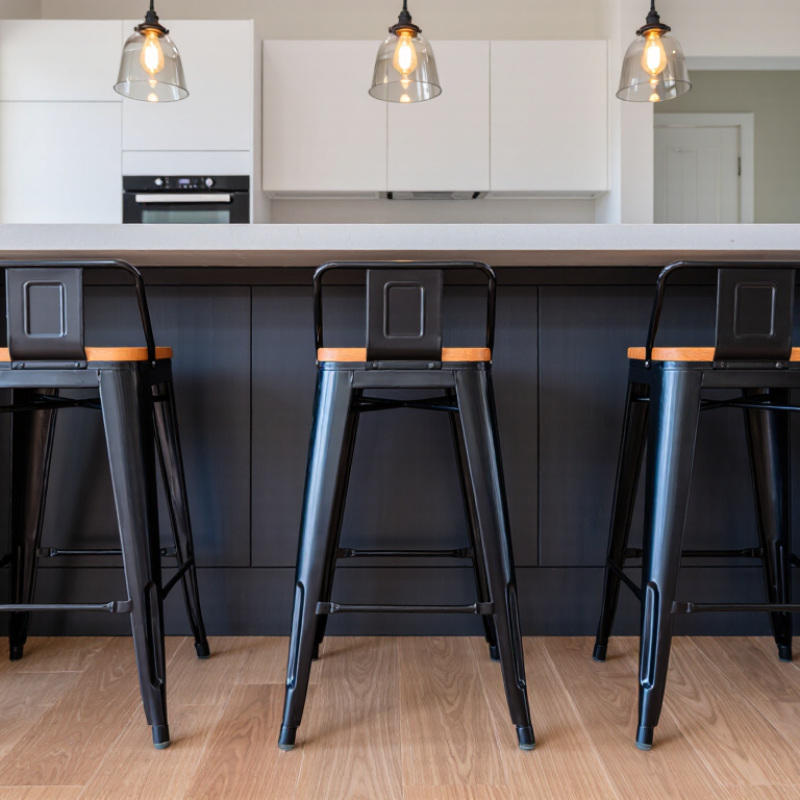
Define the space before comparing finishes or backrest styles. Measure the counter height, aisle width, and available legroom. A 36-inch counter usually pairs with a 24–26-inch seat, leaving roughly 10–12 inches between surfaces. Allow 24–30 inches of counter width per stool. This prevents elbows from colliding during breakfast or service.
I once selected stools by appearance alone. The narrow aisle became uncomfortable quickly.
Usage changes the specification. A café stool may need cleanable upholstery, a footrest, and a strong commercial frame. A workshop needs stability, chemical-resistant surfaces, and easy movement.
ANSI/BIFMA seating standards emphasize repeatable strength and durability testing, not attractive product photography. Ask for test information, weight ratings, and maintenance instructions. Claims without documentation deserve caution.
Capacity must reflect real behavior, not maximum packing. Count regular users, occasional guests, and staff who may sit briefly. For accessibility, the 2010 ADA Standards specify 30 by 48 inches of clear floor space for a forward approach. Keep one suitable position available when the layout serves the public.
The National Restaurant Association’s 2024 industry report highlights continued pressure on operating costs, so replaceable parts can matter financially. A beautiful stool that fails after constant use is not efficient. Sometimes the best choice looks less dramatic.

Choosing the right industrial counter stool begins with accurate measurements, not appearance. Most kitchen and service counters stand 34 to 36 inches high. A suitable stool usually has a 24 to 26-inch seat height. This leaves roughly 9 to 12 inches for comfortable leg movement. Measure from the finished floor to the underside of the counter. Countertop thickness can reduce usable clearance.
Overall dimensions matter just as much. Allow about 24 inches of counter width per stool for relaxed seating. A seat width of 16 to 20 inches works for many users, but wider seats need more spacing. Check the stool’s depth before ordering. A deep frame may block walkways or collide with cabinet doors. Leave at least 36 inches behind occupied stools in active areas. Tight spaces become frustrating quickly.
Footrests should support both feet without forcing the knees upward. A stable base, reinforced joints, and level glides are important on hard industrial floors. Test one sample at the counter before buying several. Sit for ten minutes. Notice pressure behind your knees and contact with the footrest. I have seen layouts that looked correct on paper but felt cramped in use. The lesson is uncomfortable but useful: standard dimensions are guides, not guarantees. A slightly lower seat may suit a thick countertop, while a higher model can make short users lean forward. Examine the real space, including people, tools, and daily movement.
The chart uses common ergonomic planning dimensions in inches. A comfortable stool typically places the seat 10–12 inches below the counter or work surface. For a standard 36-inch counter, a 24–26-inch seat is generally appropriate. Also check the stool footprint: many industrial counter stools are approximately 16–20 inches wide and 15–18 inches deep, leaving enough clearance for users and adjacent stools.
Choosing the best industrial counter stool requires more than a rugged appearance. Compare steel, wood, and molded plastic for strength, comfort, and maintenance. World Steel Association data reports 1.89 billion tonnes of crude steel production in 2023. Steel offers strong frames and reliable welds, but exposed steel can rust in humid kitchens. Powder coating helps, although chipped edges still need attention. Solid wood feels warmer, while recycled plastic resists spills and frequent cleaning. UNEP’s Global Plastics Outlook reports 353 million tonnes of plastic waste in 2019, so recycled content deserves serious consideration.
Tip 1: Inspect the joints closely. Look for continuous welds, reinforced corners, and level feet. A loose footrest becomes irritating quickly. Choose a seat height that leaves your knees near a right angle. For a 36-inch counter, a 24-to-26-inch seat often works, but measure your actual surface first. ANSI/BIFMA seating standards emphasize durability testing, yet a certified test cannot replace checking wobble on your floor.
Tip 2: Match construction to daily use. A thin metal seat may look convincingly industrial, but it can feel cold after ten minutes. Add a contoured seat or a replaceable cushion when comfort matters.
Tip 3: Examine the footrest diameter and finish. Sharp edges, hollow tubes, and weak welds reveal cost cutting. I would not trust a stool only because it carries a high weight rating. Ask how that rating was tested, and remember that real users shift, lean, and climb slightly. Industrial design should serve the worker, not merely imitate a factory.
10 Tips for Choosing the Best Industrial Counter Stool
Comfort begins with the working posture. Check seat height against the counter, then test knee clearance and foot support. A stable footring reduces dangling legs and pressure behind the thighs. Choose a seat with a shaped edge, but avoid excessive softness. Soft foam often collapses faster in busy environments. Sit, shift, and stand repeatedly. Real use is messier. Allow enough space for workers to turn safely without striking nearby equipment.
Stability deserves careful testing. Inspect the base, welds, fasteners, and floor glides. Four-leg frames can feel secure, while pedestal designs need stronger anti-tip control. ANSI/BIFMA X5.1 includes durability and stability tests for commercial seating. Ask suppliers for current test documentation, not vague claims. The U.S. Bureau of Labor Statistics recorded 885 fatal workplace injuries involving falls, slips, and trips in 2023. A stool cannot prevent every incident, but poor design can increase risk.
Maintenance affects long-term value. Select sealed surfaces that tolerate approved cleaners and frequent wiping. Avoid deep seams where dust, oil, or moisture can collect. Confirm that replacement glides and fasteners remain available. Check load capacity against real users, tools, and clothing. Examine the stool weekly for cracks, loosened joints, and rocking. I would not trust a polished sample alone. Request a trial unit and test it during a full shift. Small discomfort becomes expensive when repeated daily.
| No. | Evaluation Focus | Practical Selection Benchmark | How to Verify It | Maintenance and Safety Considerations |
|---|---|---|---|---|
| 1 | Choose the Correct Seat Height | For a standard counter, select a seat height of approximately 24–26 inches (61–66 cm). Leave about 9–12 inches (23–30 cm) between the seat surface and the underside of the counter. | Measure the counter height from the finished floor to the underside of the work surface. Confirm the stool dimension from the floor to the top of the seat, not to the top of the cushion. | Avoid seating positions that force the knees upward or leave the feet unsupported. A suitable height helps reduce pressure on the hips, knees, and lower back. |
| 2 | Prioritize Seat Comfort | Look for a seat with adequate width and depth, rounded front edges, and moderate cushioning. A seat width of about 16–18 inches (41–46 cm) is suitable for many adult users. | Sit on the stool for at least 10–15 minutes. Check that the thighs are supported without the front edge pressing into the backs of the knees. | Choose durable, closed-cell or sealed upholstery for work areas where liquids, oils, or cleaning chemicals may be present. Replace torn padding promptly. |
| 3 | Check Frame and Load Capacity | Select a stool with a published static load rating that exceeds the intended user load. For shared industrial use, a rated capacity of at least 300 lb (136 kg) is a practical baseline, unless the application requires more. | Review the manufacturer’s load-rating documentation and inspect welds, joints, fasteners, and connection points. Do not rely only on visual thickness of the metal. | Do not use the stool as a step ladder or standing platform. Load ratings generally apply to sitting use on a level surface and may not cover impact or misuse. |
| 4 | Evaluate Stability and Footprint | Prefer a broad, rigid base with four stable contact points or a properly engineered pedestal base. The frame should resist rocking, twisting, and tipping during normal seated movement. | Place the stool on a flat floor and apply moderate pressure to the seat from several directions. Check for wobble, uneven feet, frame flex, or movement at the joints. | Use adjustable leveling glides where floors are uneven. Keep all feet or the base fully supported; never place the stool on loose mats, debris, or unstable platforms. |
| 5 | Inspect the Footrest Design | Choose a continuous or well-supported footrest positioned comfortably below the seat. The footrest should support both feet without sharp edges or excessive flex. | Sit normally and confirm that the feet can rest naturally without stretching, dangling, or contacting exposed bolts. Test the footrest for movement and surface grip. | A secure footrest improves posture and reduces leg fatigue. Use a rounded, corrosion-resistant footrest and inspect it regularly for loosened welds or fasteners. |
| 6 | Select Appropriate Materials | Powder-coated steel or stainless steel is suitable for many industrial environments. Use sealed wood or high-density polymer only when their resistance matches the workplace conditions. | Identify exposure to moisture, oils, solvents, heat, welding sparks, abrasive dust, or wash-down procedures before selecting the finish and seat material. | Avoid finishes that blister, flake, or retain contaminants. For damp or corrosive areas, use corrosion-resistant hardware and promptly remove standing water. |
| 7 | Assess Cleanability and Maintenance | Favor smooth, non-porous surfaces, sealed seams, minimal crevices, and removable or replaceable components. The design should allow routine inspection without specialized tools. | Review the cleaning instructions and test whether the seat, frame, and footrest can be wiped completely. Confirm compatibility between cleaning agents and the surface finish. | Do not use abrasive cleaners or unapproved solvents that may weaken coatings or upholstery. Establish a regular cleaning schedule based on the level of contamination. |
| 8 | Consider Mobility and Floor Protection | Use fixed glides for maximum stability in production areas. Use casters only when movement is necessary and when the floor, workload, and operating environment are suitable. | Confirm that the glide or caster type matches the floor surface. Test rolling resistance, braking or locking action, and clearance from nearby equipment. | Casters can increase unintended movement and tipping risk, especially at counter height. Lockable casters and non-marking industrial glides can reduce these risks when properly selected. |
| 9 | Review Ergonomics for the Work Task | Match the stool to the task. A backrest may improve support for longer seated work, while a backless stool may provide easier access and movement for short-duration tasks. | Reproduce the actual work posture. Confirm that the user can keep the shoulders relaxed, elbows near the body, and feet supported without leaning or twisting excessively. | Alternate sitting and standing where possible. Avoid prolonged static postures, and provide a suitable foot support when the work surface is too high for the user. |
| 10 | Verify Compliance and Workplace Fit | Confirm that the stool is suitable for the intended environment, user population, and applicable workplace requirements. Check dimensions, rated capacity, materials, and replacement-part availability before purchase. | Compare the product documentation with the site’s risk assessment, cleaning procedures, floor conditions, and required clearances. Inspect a sample unit before placing a larger order. | Keep access routes, emergency equipment, and machine controls unobstructed. Remove any stool with cracked frames, damaged welds, missing hardware, unstable feet, or failed adjustment parts. |
Choosing an industrial counter stool requires more than admiring its rugged appearance. Inspect the frame, welds, and joints closely. Clean welds usually show better manufacturing control. Check the stated weight capacity, not just the visual strength. A thick steel frame can still feel unstable. Test the stool on an uneven floor. Measure twice. Confirm the seat height against your counter before ordering. A footrest should support your feet without sharp edges or awkward pressure.
Long-term value depends on materials and maintenance. Powder-coated steel resists daily scuffs, but poor finishing may chip quickly. Solid wood adds warmth, while molded materials often simplify cleaning. Ask whether replacement glides, seats, or footrests are available. Small parts eventually fail. Customization should solve a real need, not inflate the invoice. Consider seat color, backrest shape, swivel movement, and floor protection together. I once chose a stool with excellent padding, but its fixed height reduced comfort during longer work sessions.
Reliable suppliers should provide material details, dimensions, load testing, care instructions, and realistic delivery information. Request a sample when several stools will serve a busy workspace. Compare the sample with your lighting, flooring, and counter edge. Review warranty terms carefully, especially for commercial use. Calculate total cost, including assembly, shipping, repairs, and replacements. The cheapest option may become expensive after repeated repairs. Still, premium pricing does not guarantee thoughtful design. Ask practical questions, record the answers, and leave room to reconsider your original preference.
